(Audio Download / PDF / SoundCloud) DeRouchie gave this message on 5/9/2026 at the Sovereign Joy Baptist Church plant in Liberty, MO.
***
THE TEN COMMANDMENTS TO CHRIST AND THROUGH CHRIST
A Biblical-Theological Sermon on the Law in Deuteronomy 5:6–21
Jason S. DeRouchie, PhD (5/10/2026)
It is Mother’s Day, which gives Christians many opportunities to express godliness. Today, we should thank God for supplying us mothers who carried us and bore us rather than aborted us. We should, whether man or woman, be grateful for any modeling our mothers gave us to understand rightly what a woman is and what she ought to be. Some of you today need to entrust to God your longings to be a mother. Other need to cast upon him your griefs in losing a mother or in not being able to have a biological child. Others should ask him to enable you to be a wise mother or to help you love and/or honor your mother or mother-in-law. Still others should pray to God for your own mother’s wellbeing or for the wellbeing of your wife who serves as the mother of your kids. As your pastor, I encourage all of you to pursue godliness this Mother’s Day in whatever form it should take.
This is our final sermon on the Ten Commandments in Deuteronomy 5. That there are ten repetitive, concise statements (Exod 34:28; Deut 4:13; 10:4) suggests that God intended them for easy dissemination and memorization, matching our ten fingers and toes. To this end, years ago, my wife Teresa and I put the Ten Commandments to song to help disciple our own children. And today, to recall from where we have come, I want us to sing this song together. We’ll use the tune of “Row, Row, Row Your Boat.” On this Mother’s Day, if you are a mother or a son or daughter of a mother, I want you to follow along and sing with me.
| Fig. 1. GOD’S TEN WORDS I am Yahweh your God, / who saved you all from slavery. The first three focus on loving me; / the others on your neighbor. First, worship only me; / no other gods allowed. Third, observe the Sabbath day, / allowing all to rest. Fifth, respect human life. / Sixth, respect marriage. The Ninth and Tenth call to covet not / wife or property. |
As seen in figure 2, the Ten Commandments provided the outer boundaries for Israel’s relationship with God. So long as Israel lived within these boundaries, they as a people would flourish, enjoying all the covenant blessings of God’s provision and protection––their crops would grow, their wombs would produce, and their enemies would be kept at bay. However, if they rebelliously stepped outside the circle of these commands, they would experience God’s just discipline and curse manifest in the removal of provision and protection. Deuteronomy 11:26–28 captures this old covenantal structure with these words: “See, I am setting before you today a blessing and a curse: the blessing, if you obey … and the curse, if you do not obey.”
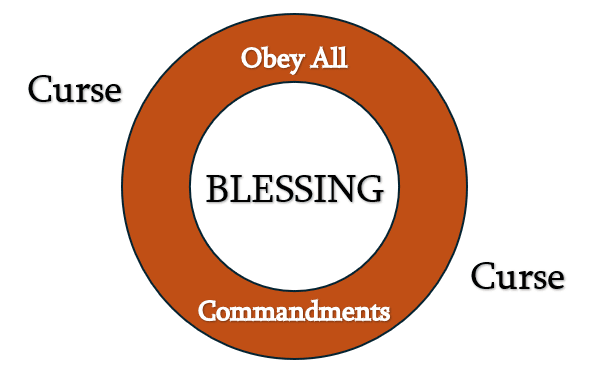 Fig. 2. The Old Covenant’s Circle of Blessing
Today, I want you to see that the old covenant was doomed for failure. The proneness of mankind to leave the right path made curse inevitable for Israel. I also hope you treasure Christ more, believing he is the only way to enjoy righteousness and life. He does what Israel could not do, and all who are in him secure the blessings of righteousness and life that were otherwise out of reach for every mere human. Yet as Christ fulfills Moses’s law, summarized in the Ten Commandments, he also recasts the law from an instrument of death to a guide for living. Today’s message has four points, and I have put each on the screen to help you track.
1. Moses’s Law Required Perfect
Obedience for Righteousness and Life
Through the Ten Commandments and the rest of the law that followed, Moses directed Israel how to love God and neighbor. By obeying God’s law, Israel would be counted righteous and live. Moses said, “It will be righteousness for us, if we are careful to do all this commandment” (Deut 6:25). He also charged, “The whole commandment that I command you today you shall be careful to do, that you may live” (8:1; cf. 4:1; Lev 18:5). Righteousness and life were the goals and not the grounds or bases of the old covenant relationship. Moses declared,
See, I have set before you today life and good, death and evil. If you obey the commandments of the LORD your God that I command you today, … then you shall live and multiply, and the LORD your God will bless you in the land that you are entering to take possession of it. But if your heart turns away, and you will not hear, but are drawn away to worship other gods and serve them, I declare to you today, that you shall surely perish. (30:15–18)
Throughout Deuteronomy, Moses regards obedience to the law the means for being counted righteous and for enjoying life. Yet disobedience would bring death.
2. Israel Disobeyed, So Moses’s Law Destroyed Them
Death is what God would bring to Israel. The old covenant law would condemn them because they were stubborn and would continue to be, making their future rebellion certain. Hear Moses’s words in Deuteronomy 9:
Know … that the LORD your God is not giving you this good land to possess because of your righteousness, for you are a stubborn people. Remember and do not forget how you provoked the LORD your God to wrath in the wilderness. From the day you came out of the land of Egypt until you came to this place, you have been rebellious against the LORD. (Deut 9:6–7)
“Unrighteous, stubborn, rebellious”––these are the terms Moses uses to describe those he shepherded for forty years. I praise the Lord Sovereign Joy is not like that congregation! Building off these realities, Moses commanded, “Circumcise therefore the foreskin of your heart, and be no longer stubborn” (10:16). Israel’s hearts were sick, and Moses says, “Take this knife and fix yourself!” How successful would doing open heart surgery on yourself be? You would die! And this would happen to Israel so long as they sought to acquire righteousness and life by works. We can’t obey perfectly or fix our problems independently. We need outside help. Until God would overcome their spiritual disability, they would remain stubborn, rebellious, and unbelieving, resulting in condemnation (Deut 29:4; cf. 30:6). The old covenant law would ruin them.
Yahweh says this much in 31:16–17:
Behold, you are about to lie down with your fathers. Then this people will rise and whore after the foreign gods among them in the land that they are entering, and they will forsake me and break my covenant that I have made with them. Then my anger will be kindled against them in that day, and I will forsake them and hide my face from them, and they will be devoured. (Cf. 4:25–28)
Moses then adds, “I know how rebellious and stubborn you are. Behold, even today while I am yet alive with you, you have been rebellious against the LORD. How much more after my death!” (31:27). Moses is clear that the old covenant would culminate in Israel’s destruction, and the rest of the Old Testament testifies this happened. Israel entered the Promised Land, but centuries of rebellion resulted in ruin. They experienced the curses of the covenant, climaxing in exile and death.
Reflecting on these features, Paul stresses that “the law is holy, and the commandment is holy and righteous and good” (Rom 7:12; cf. 2:20). Nevertheless, he also says, “The very commandment that promised life proved to be death to me” (7:10). In God’s ultimate redemptive purposes, the law of Moses bore a “ministry of death” and “condemnation” that would be superseded by the new covenant’s “ministry of righteousness” (2 Cor 3:7, 9).
God gave the law to give “knowledge of sin” and by this to show that “by works of the law no human being will be justified in his sight” (Rom 3:20; cf. Gal 2:16). No mere humans can be declared right before God by means of obedience to God’s law, because no mere humans can perfectly meet the law’s demands. As Paul says, “All who rely on works of the law are under a curse; for it is written, ‘Cursed be everyone who does not abide by all things written in the Book of the Law, and do them’” (Gal 3:10; cf. Deut 27:26). Nevertheless, God sent his perfect Son “to redeem those who were under the law” (Gal 4:4–5).
3. Jesus Is Our Only Hope for Righteousness and Life
Whereas in the old covenant, Moses wrote of “the righteousness that is based on the law” (Rom 10:5; cf. Lev 18:5), the prophet looked ahead to the new covenant, seeing in it “the righteousness that is based on faith” (Rom 10:6–9; cf. Deut 30:12–14). Israel’s inability to keep the law perfectly should have made them hope in this day and that God would, in fulfillment of his pledge, provide an unblemished substitute to satisfy the law’s requirements and secure for all in him the righteousness and life the law promised. This is what happens in the gospel.
What we need is to “be found in [Jesus], not having a righteousness of [our] own that comes from the law, but that which comes through faith in Christ, the righteousness from God that depends on faith” (Phil 3:9; cf. Tit 3:4–7). Paul says “that Gentiles who did not pursue righteousness have attained it, that is, a righteousness that is by faith; but that Israel who pursued a law that would lead to righteousness did not succeed in reaching that law. Why? Because they did not pursue it by faith, but as if it were based on works” (Rom 9:30–32). He then adds, “The end of the law is Christ for righteousness to everyone who believes” (10:4).
From the beginning, the goal and end of Moses’s law was Jesus for righteousness. No mere human could perfectly keep the Ten Commandments for righteousness and life. So, God met his own demands through Jesus’s perfect obedience and sacrifice. “God has done what the law, weakened by the flesh, could not do. By sending his own Son in the likeness of sinful flesh and for sin, he condemned sin in the flesh, in order that the righteous requirement of the law might be fulfilled in us” (8:1, 3–4; cf. 5:18–19; 2 Cor 5:21; Col 2:14).
Before treating the Ten Commandments as guides for life, Christians should first see them pointing us to Jesus as our source of life. Moses law helps us celebrate Jesus’s justifying work, by which he declares us right with God and gives us lasting life. Yet there is more. “Now that you have been set free from sin and become slaves of God, the fruit you get leads to sanctification and its end, eternal life” (Rom 6:22). In this realm of progressive holiness, the Ten Commandments shift from pointing us to Jesus to guiding us through Jesus in right living.
4. Moses’s Law as Fulfilled through Christ Still Guides Christians Today
The Ten Commandments are part of the old covenant, not the new, and Christians are under the law of Christ, not the law of Moses (1 Cor 9:20–21; cf. Gal 6:2; Heb 8:13). Thus, none of the Ten Commandments serve as a direct authority or guide for believers today. Yet these sermons have shown that, through Christ, all the Ten Commandments still instruct us in the way they clarify God’s unchanging character and values, anticipate and magnify the person and work of Jesus, and portray the far-ranging scope of love for God and neighbor.
In the Sermon on the Mount, Jesus stresses that Moses’s law still matters when considered in view of his teaching and ministry. Jesus says that he did not come to “abolish” the Old Testament but to “fulfill” it by realizing in his life all that it called for and anticipated (Matt 5:17). For Jesus, there is lasting significance in the Old Testament when considered in relation to him. One way this is seen is in how we approach Moses’s law, which is the focus of his next statements.
Truly, I say to you, until heaven and earth pass away, not an iota, not a dot, will pass from the Law until all is accomplished. Whoever relaxes one of the least of these commandments and teaches others to do the same will be called least in the kingdom of heaven, but whoever does them and teaches them will be called great in the kingdom of heaven. (5:18–19)
Jesus’s followers must still do and teach Moses’s commands, but only in view of how Jesus fulfills them. Consider figure 3.
Fig. 3. The Law through the Lens of Christ
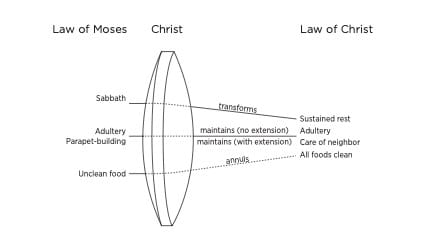
Jesus’s teaching and ministry are like a lens through which to consider the lasting significance of Moses’s instruction. Some laws seem unchanged before and after Christ, whereas others hit the lens and get “bent” in various ways. Jesus’s coming maintains (with or without extension), transforms, or annuls various laws.
1. Jesus maintains some laws without extension.
When moving from the old covenant to the new, Christ’s teaching and ministry reaffirms some of the law without any alteration. Thus, Jesus identifies sins flowing from the heart like “evil thoughts, murder, adultery, sexual immorality, theft, false witness, [and] slander” as things that defile a person (Matt 15:18–19; cf. 19:17–21). Similarly, Paul stresses to the Roman Christians: “The commandments, ‘You shall not commit adultery, You shall not murder, You shall not steal, You shall not covet,’ and any other commandment, are summed up in this word: ‘You shall love your neighbor as yourself’” (Rom 13:9). Laws that are maintained without extension are those where obeying them looks the same in both the old and new covenants. Thus, adultery is prohibited both before and after Christ, and the law itself is not altered in any way. All but the Sabbath law in the Ten Commandments seem to be of this nature.
2. Jesus maintains certain laws with extension.
“Extension” means that through Jesus certain commands in the old covenant apply in new ways or to new people. For example, through Jesus (Matt 10:10), Paul extends Moses’s charge to allow oxen to eat grain while they are working (Deut 25:4) to the need to pay solid wages to ministers. “Let the elders who rule well be considered worthy of double honor, especially those who labor in preaching and teaching. For the Scripture says, ‘You shall not muzzle an ox when it treads out the grain,’ and, ‘The laborer deserves his wages’” (1 Tim 5:17–18; cf. 1 Cor 9:8–12). Similarly, Moses’s requirement that low walls (or parapets) be built around the perimeter of flat roofed houses to guard against accidental injury (Deut 22:8) equally requires that Christians put a railing around a deck, salt an icy sidewalk, or add a baby gate at a stairwell. Through Christ, the moral principle in the law is maintained with extension. When the old covenant law includes cultural or situational details that are different from our own, we heed Jesus’s words at the end of the parable of the good Samaritan and “do likewise” (Luke 10:37), applying the principle in fresh contexts.
3. Jesus transforms some laws.
Jesus’s person and work fulfill certain laws in a way that their continuation is radically transformed––still applicable but in a newly realized way. This is how I interpreted the Sabbath law (Deut 5:12–15). Thus, Israel’s 6+1 weekly pattern reminded them of their mission to see rest in relation to God realized once again on a global scale, and what Israel hoped for Jesus fulfills, declaring as “lord of the Sabbath,” “Come to me, all who labor and are heavy laden, and I will give you rest” (Matt 11:28; 12:8). The last day of the week is no longer the Sabbath, but instead every day Christians enjoy rest in relation to Christ, even as we hope for when that rest will be final and complete. Likewise, in Moses’s law, the charge “purge the evil from Israel” related to enacting the death penalty on criminals (e.g., Deut 22:22). However, in 1 Corinthians Paul applies the charge to a local church’s practice of excommunication as the climax of church discipline: “Purge the evil person from your midst” (1 Cor 5:13). Thus, the old covenant law still applies but is transformed within its new covenant context.
4. Jesus annuls some laws.
Jesus’s teaching and ministry actually puts an end to certain laws. For example, in relation to Moses’s charge that Israel could not eat unclean animals (e.g., Lev 20:25–26), Christ, having defeated the unclean serpent, now declares all foods clean (Mark 7:19). And with such awareness (Acts 10:14–15), Peter knew this implied that he “should not call any person common or unclean” (10:28). Although Jesus’s fulfillment of these laws means he rescinded the dietary restrictions, we as his followers still benefit from the commands by considering what they tell us about God and Jesus’s victory over all that is unclean.
Conclusion
Within the old covenant, Moses’s law functioned to identify and multiply sin (Rom 3:20; 5:20) and to condemn Israel (2 Cor 3:9), thus showing their desperate need for Jesus. In condemning Israel, the law also condemned the world, for if Israel, with the law, could not glorify God rightly, the rest of the world without the law has no hope of living his way (Rom 3:19). Truly, “by works of law no human being will be justified” (3:20; cf. Gal 3:16).
In God’s purposes, “the end of the law” was always “Christ for righteousness to everyone who believes” (Rom 10:4). God made righteousness and life the goals of Moses’s law, not the grounds. Yet Israel could never attain what they were seeking (9:30–32; 11:7–8). But when Christ, the perfect Righteous One, came, he secured righteousness and life for all who are in him. Before the law becomes a gift to guide us, the law must first kill us, showing us that believing in Christ alone is our means for right standing before God. We react harshly to our spouse; we express impatience with our kids; we prioritize things over our relationship with God and thus engage in idolatry; we let our eyes lust or our hands steal or our mouths lie. All these acts fail to align with God’s law and thus reveal our need for a Savior. The law leads us to Christ for justification and life.
Yet having “been set free from sin” and having “become slaves of God,” “the fruit you get leads to sanctification and its end, eternal life” (6:22). That is, Jesus died and rose not only to justify us but also to sanctify us, not only to free us from sin’s penalty but also to free us from sin’s power. He “gave himself for us to redeem us from all lawlessness and to purify for himself a people for his own possession who are zealous for good works” (Tit 2:14). Through Jesus, you can respond to your spouse and kids with gentleness and patience. Through Jesus, you can curb laziness and prioritize prayer and Bible reading. With Jesus’s help, you can value what God values and love what God loves, keeping your eyes from lust and your heart from coveting and your lips from speaking deceit. Through Jesus, Moses’s law moves from being a law that kills to a law that guides.
The Ten Commandments still matter for believers today. Memorize them to instruct your kids and/or to apply them in your life. Let these ancient laws move you to Christ and guide you through Christ. Let Moses’s law help you treasure Jesus by celebrating his justifying work, wherein his perfect obedience to the law reconciles you to God, and then by cherishing his sanctifying work, wherein his blood-bought power helps us love God and love neighbor faithfully and truly. Pray with me….